🔬Introduction
Fat metabolism is one of the body's essential energy-producing processes. While carbohydrates provide a readily available energy source, fatty acids also serve as an important fuel, particularly during prolonged physical activity and periods of increased energy demand.
One key compound involved in this process is L-Carnitine, which plays an essential role in transporting long-chain fatty acids into mitochondria, where they can be broken down to produce energy.
Rather than acting as a fat-burning substance itself, L-Carnitine functions as a transporter within the body's metabolic system. Understanding this mechanism helps explain its importance in nutritional science, sports nutrition, and the development of functional food ingredients.
⚙️ 1. How L-Carnitine Supports Fatty Acid Transport
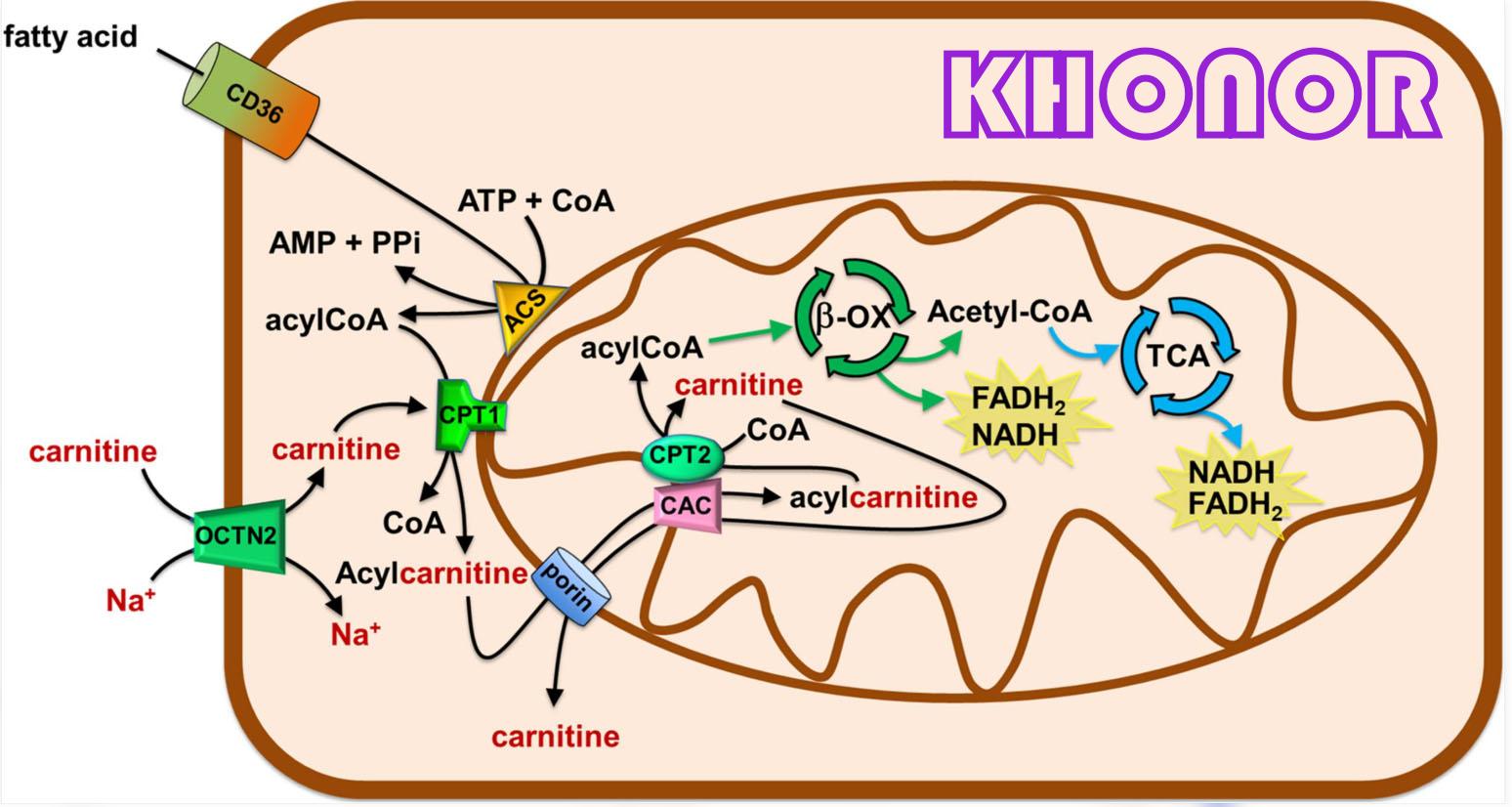
Long-chain fatty acids cannot efficiently cross the inner mitochondrial membrane on their own. They require a specialized transport mechanism known as the carnitine shuttle system.
L-Carnitine participates in this process through three main steps:
1.1 Fatty Acid Activation
Before entering the mitochondrial energy pathway, long-chain fatty acids are converted into fatty acyl-CoA by specific enzymes.
1.2 Formation of Acylcarnitine
Carnitine palmitoyltransferase I (CPT I) transfers the fatty acyl group from CoA to L-Carnitine, forming acylcarnitine. This transformation allows the fatty acid group to be transported across the mitochondrial membrane.
1.3 Mitochondrial Transport and Release
Acylcarnitine is transported across the inner mitochondrial membrane by carnitine-acylcarnitine translocase (CACT). Carnitine palmitoyltransferase II (CPT II) then converts it back into fatty acyl-CoA inside the mitochondrial matrix.
The fatty acyl-CoA can subsequently enter beta-oxidation, while free carnitine is recycled for further transport.
This transport mechanism is particularly important for the utilization of long-chain fatty acids in cellular energy metabolism.
🔋 2. The Connection Between L-Carnitine and ATP Production
Once fatty acids enter the mitochondrial matrix, they undergo a process called beta-oxidation.
During this process, fatty acid molecules are progressively broken down into acetyl-CoA units. These units enter the tricarboxylic acid (TCA) cycle, generating reducing equivalents that support oxidative phosphorylation and ATP production.
ATP (adenosine triphosphate) is the primary energy-carrying molecule used by cells to support various biological activities.
L-Carnitine therefore contributes to energy metabolism by facilitating the transport of long-chain fatty acids into mitochondria, making their subsequent oxidation possible.
Its role is especially relevant to tissues with substantial energy requirements, including skeletal muscle and the heart.
🏃 3. Why L-Carnitine Is Relevant to Sports Nutrition
Skeletal muscles rely on multiple energy sources, including carbohydrates and fatty acids. The contribution of each source varies according to exercise intensity, duration, nutritional status, and individual metabolic characteristics.
Because L-Carnitine participates in fatty acid transport, it has attracted considerable interest in sports nutrition research.
Areas of scientific investigation include:
Fatty Acid Utilization: Its involvement in transporting long-chain fatty acids for mitochondrial oxidation.
Exercise Metabolism: Its relationship with energy substrate utilization during physical activity.
Muscle Energy Balance: Its involvement in regulating the balance between free carnitine and acylcarnitine.
Exercise Recovery: Researchers have investigated potential relationships between carnitine supplementation, muscle soreness, and recovery.
However, the results of human studies on exercise performance are mixed. The physiological role of L-Carnitine in fat metabolism should not be interpreted as proof that supplementation automatically improves athletic performance or accelerates fat loss.
🧬 4. L-Carnitine and Metabolic Flexibility
Metabolic flexibility refers to the body's ability to adjust its energy substrate utilization according to changing physiological conditions.
For example, the body may rely more heavily on carbohydrates during high-intensity exercise while increasing its reliance on fatty acids during lower-intensity, prolonged activity.
The carnitine system contributes to this metabolic regulation in several ways:
4.1 Fatty Acid Oxidation
L-Carnitine facilitates the mitochondrial transport of long-chain fatty acids, supporting their utilization through beta-oxidation.
4.2 Acyl Group Balance
The carnitine pool also participates in transferring acyl groups and maintaining the balance between free CoA and acyl-CoA within mitochondria.
4.3 Mitochondrial Metabolism
Through its involvement in fatty acid transport and acyl-group metabolism, L-Carnitine contributes to the coordination of different energy-producing pathways.
These functions make L-Carnitine an important subject in research on cellular metabolism and metabolic health.
📊 5. Quality Considerations for L-Carnitine Raw Materials
For manufacturers developing nutritional products and functional food formulations, the quality and consistency of L-Carnitine raw materials are important considerations.
Beyond the product name and stated concentration, several analytical parameters help evaluate product quality.
Important quality indicators include:
L-Carnitine Content: Indicates the concentration of the active ingredient.
Loss on Drying: Helps assess moisture and volatile matter in the material.
Specific Rotation: An important identification and quality-control parameter for optically active L-Carnitine.
pH: Provides information about the acidity or alkalinity of an aqueous solution.
Particle Size: Influences powder handling, mixing, and formulation processes.
KhonorChem L-Carnitine 50% – COA Quality Profile
KhonorChem's LC 50% L-Carnitine product is supplied as a white or almost white powder. The following results are taken from the product's Certificate of Analysis (COA).
| Quality Parameter | Specification | COA Result |
|---|
| L-Carnitine Content (Dry Basis) | ≥50.0% | 50.9% |
| Loss on Drying | ≤7.0% | 3.3% |
| Specific Rotation | -14.0° to -16.0° | -14.5° |
| pH (5% Aqueous Solution) | 6.5–8.5 | 6.5 |
| Particle Size | Through 60 mesh | >95% passed |
Additional product information:
These analytical parameters provide buyers with a practical reference when evaluating raw material consistency and suitability for their formulation requirements.
🌍 6. Applications in Nutritional Product Development
L-Carnitine is used in the development of various nutritional products, depending on the ingredient form, concentration, regulatory requirements, and intended market.
Common product development areas include:
Sports Nutrition: Ingredient development for sports-oriented nutritional formulations.
Weight Management Products: Used in formulations targeting energy metabolism, although clinical evidence for weight-loss benefits remains limited.
Functional Nutrition: Incorporated into nutritional products designed around energy metabolism.
Dietary Supplements: Available in capsules, tablets, powders, and liquid formulations.
For manufacturers, selecting an appropriate L-Carnitine specification is an important step in achieving consistent formulation performance.
✅ Conclusion
L-Carnitine is more than a popular nutritional ingredient. Its role in the carnitine shuttle system makes it an essential component of long-chain fatty acid transport and an important contributor to mitochondrial energy metabolism.
From fatty acid oxidation to the regulation of mitochondrial acyl-group balance, L-Carnitine remains an important ingredient in nutritional science and functional product development.
For manufacturers and ingredient buyers, understanding both its metabolic function and raw material quality parameters can help support more informed sourcing and formulation decisions.
Looking for L-Carnitine raw materials?
KhonorChem provides L-Carnitine 50% with batch-specific COA documentation. Contact our team for product specifications, technical documents, and quotation information.

📧 Email: mengling@khonorchem.com
📞 Tel/WhatsApp/WeChat: +86-19851820586
🌏 WhatsApp:https://wa.me/8619851820586
 English

 Spain
 ruso
 Portuguese
 italiano
 Arabic
 French
 Korean
 German
 Turkish
 Vietnamese
 Indonesian
 Dutch
 Polish
 Far
 Thai



 0086-19851820586
 mengling@khonorchem.com
 Rm 1902 Easey Comm Bldg, 253-261, Hennessy RD Wanchai HK