1. Product Description
Alginate Oligosaccharides (AOS) are low-molecular-weight bioactive carbohydrates obtained through the degradation of alginate, a natural polysaccharide primarily extracted from brown seaweed. They consist of short chains of uronic acid units, mainly β-D-mannuronic acid (M) and α-L-guluronic acid (G), which are the two principal building blocks of alginate.
Compared with high-molecular-weight alginate, Alginate Oligosaccharides have shorter molecular chains, generally offering better water solubility and distinct biological activities. They can be produced through enzymatic hydrolysis, chemical hydrolysis, or other controlled degradation processes, depending on the desired molecular weight and structural characteristics.
In agriculture, Alginate Oligosaccharides are recognized for their potential to promote plant growth and regulate physiological responses. They can stimulate root development, support plant vigor, and help plants respond to environmental stresses such as drought, salinity, and pathogen challenges. Their biological activities make them valuable ingredients in agricultural biostimulants, plant nutrition products, and specialty crop protection formulations.
Alginate Oligosaccharides are also studied in food science, animal nutrition, biotechnology, and other fields because of their diverse biological properties.
With their marine-derived origin and multifunctional characteristics, AOS are increasingly attracting attention as bioactive ingredients for modern agricultural and specialty formulations.
Free 📄COA 📘 MSDS 📑 TDS downloads:
 COA -Alginate Oligosaccharides
MSDS-Alginate Oligosaccharides
TDS - Alginate Oligosaccharides
2. Chemical & Physical Properties
Alginate Oligosaccharides are carbohydrate oligomers composed primarily of mannuronic acid and guluronic acid residues linked through glycosidic bonds. Their molecular weight, degree of polymerization, M/G ratio, and structural composition depend on the original alginate source and the degradation process.
Parameter | Description |
|---|
Product Name | Alginate Oligosaccharides |
Abbreviation | AOS |
Synonyms | Alginate Oligomers, Algin Oligosaccharides |
Source | Brown Seaweed / Alginate |
Chemical Classification | Oligosaccharides |
Main Components | Mannuronic Acid (M) and Guluronic Acid (G) Oligomers |
Molecular Structure | Linear Oligosaccharide Chains |
Molecular Weight | Depends on Degree of Polymerization |
Appearance | Product-grade dependent |
Solubility | Generally water-soluble |
Odor | Product-grade dependent |
Biological Characteristics | Plant Growth Promotion and Biological Regulation |
2.1. Molecular Structure
Alginate Oligosaccharides consist of short chains of mannuronic acid and guluronic acid units. They may contain mannuronate oligomers (MAOS), guluronate oligomers (GAOS), or mixed mannuronate-guluronate oligomers (HAOS).
2.2. Water Solubility
Due to their relatively short molecular chains, AOS generally exhibit better water solubility than high-molecular-weight alginate. This characteristic makes them suitable for aqueous agricultural formulations and liquid biostimulant products.
2.3. Molecular Weight and Polymerization
The molecular weight and degree of polymerization (DP) are important factors influencing the biological activity and functional characteristics of Alginate Oligosaccharides. Different production processes can generate products with different molecular weight distributions and biological properties.
2.4. Biological Activity
AOS have been investigated for their ability to regulate plant physiological processes, stimulate plant growth, and activate plant defense responses. Their activity may vary according to molecular structure, concentration, and application conditions.
3. Specifications
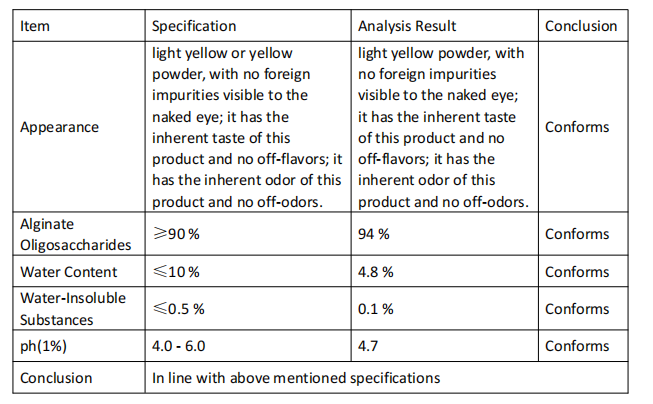
Quality Control Considerations:
3.1. AOS Content: Indicates the content of active alginate oligosaccharides in the product.
3.2. Molecular Weight: An important parameter affecting solubility, structural characteristics, and biological activity.
3.3. Degree of Polymerization: Helps characterize the distribution of oligosaccharide chain lengths.
3.4. Water Solubility: Important for preparing liquid fertilizers, foliar sprays, and other aqueous agricultural formulations.
3.5. Moisture and Ash: Important quality indicators for evaluating product stability and composition.
4. Applications
Alginate Oligosaccharides have attracted considerable interest in agriculture because of their biological activities and potential to regulate plant growth and stress responses. They can be incorporated into various agricultural formulations and specialty products.
4.1. Plant Growth Promotion
AOS can stimulate plant growth and support physiological activities at different growth stages. They are used in agricultural biostimulant formulations designed to improve overall plant vigor and development.
4.2. Root Development
Alginate Oligosaccharides have been studied for their ability to promote root development, including root elongation and root system formation. A well-developed root system can help plants absorb water and nutrients more efficiently.
4.3. Nutrient Utilization
AOS can be incorporated into plant nutrition formulations to support root activity and plant physiological processes associated with nutrient utilization. They are suitable for combination with selected fertilizers and other agricultural ingredients.
4.4. Stress Resistance
AOS have demonstrated potential in supporting plant responses to environmental stresses, including drought, salinity, and other unfavorable growing conditions. They can activate plant defense-related responses and help plants adapt to environmental challenges.
4.5. Plant Immunity and Defense
Alginate Oligosaccharides can act as elicitors of plant defense responses. They have been investigated for their ability to activate plant immune signaling pathways and support natural defense mechanisms against certain pathogen challenges.
4.6. Crop Quality and Post-Harvest Applications
AOS have also been studied for their potential role in regulating plant physiological processes associated with fruit ripening, quality maintenance, and post-harvest preservation.
4.7. Agricultural Biostimulant Formulations
Alginate Oligosaccharides can be used as functional ingredients in liquid fertilizers, foliar sprays, root application products, seed treatment formulations, and other specialty agricultural biostimulants.
4.8. Animal Nutrition and Food Research
Beyond agriculture, AOS are also investigated for their potential prebiotic and biological activities in animal nutrition and food-related research. Their suitability for commercial applications depends on the product grade and relevant regulatory requirements.
5. Advantages
5.1. Marine-Derived Raw Material
Alginate Oligosaccharides are derived from alginate, a natural polysaccharide primarily sourced from brown seaweed, making them attractive ingredients for marine-based agricultural formulations.
5.2. Low-Molecular-Weight Structure
Compared with conventional alginate, AOS have shorter molecular chains, generally offering improved water solubility and distinctive biological characteristics.
5.3. Plant Growth Promotion Potential
AOS have been studied for their ability to support plant growth and development, making them valuable ingredients in agricultural biostimulant formulations.
5.4. Root Development Support
Their potential to stimulate root growth makes them suitable for formulations targeting root development and plant establishment.
5.5. Environmental Stress Response
AOS can activate plant defense-related responses and have potential applications in formulations designed to support plant tolerance to drought, salinity, and other environmental stresses.
5.6. Versatile Formulation Compatibility
Their water-soluble characteristics make them suitable for evaluation in various aqueous agricultural formulations, including foliar sprays, liquid fertilizers, and root application products.
5.7. Multiple Agricultural Applications
AOS can be incorporated into different agricultural products, offering flexibility for crop nutrition, plant growth regulation, and specialty biostimulant development.
6. Packaging & Storage
6.1. Packaging
Alginate Oligosaccharides can be supplied in suitable moisture-resistant packaging according to product form, customer requirements, and transportation conditions.
Typical packaging options for powder products may include:
6.1.1. 1 kg or 5 kg aluminium foil bags.
6.1.2. 20 kg or 25 kg fibre drums or lined bags.
6.1.3. Customized packaging according to customer requirements.
Packaging options above are suggested formats and should be confirmed against actual supplier availability.
6.2. Storage Conditions
6.2.1. Store in a cool, dry, and well-ventilated place.
6.2.2. Keep the packaging tightly sealed when not in use.
6.2.3. Protect the product from moisture, direct sunlight, and excessive heat.
6.2.4. Avoid exposure to humid environments to prevent moisture absorption and product deterioration.
6.2.5. Store away from incompatible substances and potential sources of contamination.
6.3. Shelf Life
The shelf life should be determined according to the manufacturer's stability data and product-specific COA or TDS. Refer to the original packaging for the manufacturing date and expiry date.
7. Regulatory Status
Alginate Oligosaccharides are used or investigated in several fields, including agriculture, food science, animal nutrition, and biotechnology. Regulatory classification depends on the product grade, composition, intended application, and destination market.
Why Choose Jiangsu Khonor Chemicals Co., Limited?
✅ Over 10 years of experience in chemical and food ingredient exports
📦 Stable supply capacity and competitive pricing
⚗️ Support for diverse molecular weights and performance requirements
🧪 Samples available for quality testing
📄 Professional documentation: COA, MSDS, TDS, and export compliance
🌐 Strong focus on global B2B markets
🚚 Fast delivery and flexible logistics solutions

For quotations, specifications, samples, or technical support, please contact:
📧 Email: mengling@khonorchem.com
📞 Tel/WhatsApp/WeChat: +86-19851820586
🌏 WhatsApp:https://wa.me/8619851820586
 English

 Spain
 ruso
 Portuguese
 italiano
 Arabic
 French
 Korean
 German
 Turkish
 Vietnamese
 Indonesian
 Dutch
 Polish
 Far
 Thai



 0086-19851820586
 mengling@khonorchem.com
 Rm 1902 Easey Comm Bldg, 253-261, Hennessy RD Wanchai HK