A Supply Chain Analysis of Raw Materials and Market Pricing Trends
1. Introduction
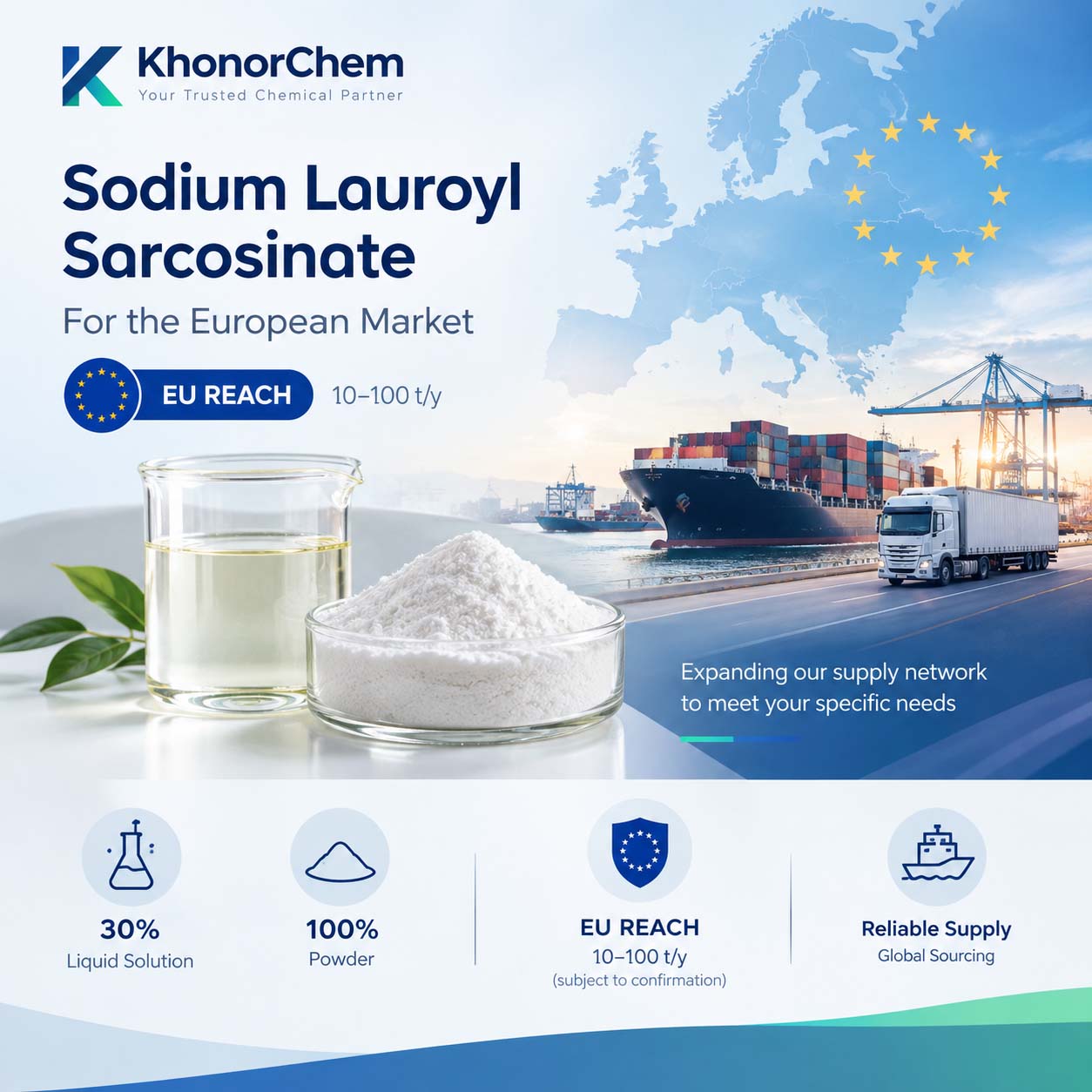
Sodium Lauroyl Sarcosinate is a widely used mild amino acid surfactant applied in facial cleansers, shampoos, and baby care formulations.
Unlike simple commodity chemicals, its pricing is influenced by a multi-layer supply chain rather than a single raw material.
Understanding its cost structure helps buyers make better sourcing decisions.
2. Key Raw Materials Behind the Cost Structure
The production of Sodium Lauroyl Sarcosinate depends on several key inputs:
Lauric Acid (C12–C14 fatty acids)
Derived from coconut oil and palm kernel oil.
Sarcosine (N-methylglycine)
A specialty amino acid intermediate.
Chloroacetic acid and alkali agents
Used in synthesis and neutralization.
Among these, Lauric Acid is the most significant cost driver, as it is directly linked to global vegetable oil markets.
3. Impact of Global Vegetable Oil Markets
Since Lauric Acid originates from natural oils, its price is influenced by:
Coconut and palm kernel oil supply cycles
Weather conditions in Southeast Asia
Biodiesel production demand
Global edible oil consumption trends
As a result, Sodium Lauroyl Sarcosinate pricing often reflects delayed but amplified movements in vegetable oil markets.
4. Supply Side Dynamics
Beyond raw materials, supply conditions also play an important role:
Plant operating rates in China and Asia
Environmental regulations affecting chemical production
Export demand from Europe and North America
Logistics and freight cost fluctuations
Even with stable raw materials, tight supply can push prices upward.
5. Demand Growth from Mild Surfactant Trends
Market demand continues to grow due to:
Shift toward sulfate-free formulations (SLS/SLES replacement)
Increasing demand for mild and skin-friendly ingredients
Expansion in baby care and sensitive skin products
Growth in premium personal care markets
This structural demand provides long-term support for pricing stability.
6. Market Outlook
Sodium Lauroyl Sarcosinate sits between commodity surfactants and specialty amino acid surfactants.
Therefore, its pricing behavior is:
7. Conclusion
The price of Sodium Lauroyl Sarcosinate is not determined by a single factor.
Instead, it is shaped by:
Global vegetable oil markets
Raw material availability
Regional production capacity
Long-term personal care industry trends
For buyers and formulators, understanding these dynamics is essential for smarter procurement decisions.

📧 Email: mengling@khonorchem.com
📞 Tel/WhatsApp/WeChat: +86-19851820586
🌏 WhatsApp:https://wa.me/8619851820586
 English

 Spain
Spain ruso
ruso Portuguese
 italiano
 Arabic
 French
 Korean
 German
 Turkish
 Vietnamese
 Indonesian
 Dutch
Dutch Polish
 Far
Far Thai
Thai


 0086-19851820586
  mengling@khonorchem.com
  Rm 1902 Easey Comm Bldg, 253-261, Hennessy RD Wanchai HK