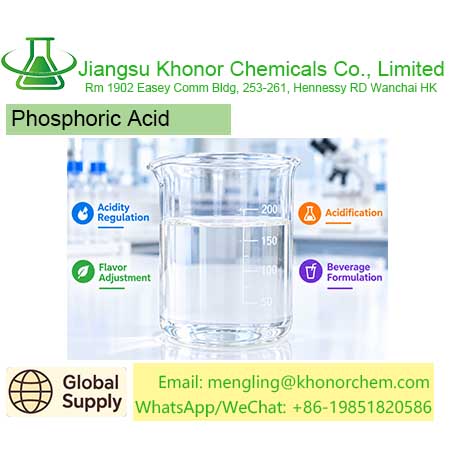
Phosphoric acid is widely used in fertilizer production, food processing, metal treatment, and the manufacture of phosphate salts. Its market movements can provide useful information for buyers sourcing phosphate-based chemicals from China.
However, a change in the phosphoric acid price does not automatically translate into an equivalent change in the price of every phosphate product.
1. What Influences Phosphoric Acid Prices?
Several factors can affect the Chinese phosphoric acid market:
Raw material costs: Phosphate rock, sulfur, and other production inputs can influence manufacturing costs, depending on the production route.
Production and supply: Plant maintenance, operating rates, regional supply availability, and inventory levels may affect market quotations.
Downstream demand: Fertilizers and other phosphate-consuming industries influence demand, while different end-use sectors may respond differently to market changes.
Regional and export conditions: Domestic prices and export offers can differ because of transportation, product specifications, taxes, and commercial terms.
2. What Did the Recent Market Signals Show?
Shengyi Society (100ppi) reported that China's phosphoric acid price indicator showed weakening downward momentum on September 28, 2026. On September 29, its 10-day moving average crossed its 20-day moving average, generating a technical signal associated with a potential change in market direction.
These signals are useful for monitoring short-term momentum, but they should not be interpreted as proof of a lasting price increase. Actual transaction prices may also vary by region, grade, supplier, and delivery conditions.
3. How Can Buyers Manage Price Uncertainty?
For overseas procurement teams, several practices can help reduce uncertainty:
· Request updated quotations when market conditions change.
· Confirm whether the product is wet-process or thermal-process phosphoric acid, where relevant.
· Specify the required concentration, purity, and grade.
· Compare quotations using the same Incoterms and shipment quantities.
· Check stock availability, production lead time, and quotation validity before confirming an order.
4. Does a Lower Phosphoric Acid Price Always Mean Lower Product Costs?
Not necessarily. Finished phosphate products also involve conversion costs, energy, labor, quality control, packaging, and transportation.
For example, calcium phosphate and potassium phosphate products may respond differently to changes in phosphoric acid prices because their manufacturing processes and other raw material requirements differ.
Conclusion
Phosphoric acid price trends are one useful reference for phosphate chemical buyers, but purchasing decisions should be based on the full cost structure and the requirements of the finished product.
Monitoring market data alongside supplier quotations helps buyers evaluate offers more effectively and plan procurement with greater confidence.

📧 Email: mengling@khonorchem.com
📞 Tel/WhatsApp/WeChat: +86-19851820586
🌏 WhatsApp:https://wa.me/8619851820586
 English

 Spain
 ruso
 Portuguese
 italiano
 Arabic
 French
 Korean
 German
 Turkish
 Vietnamese
 Indonesian
 Dutch
 Polish
 Far
 Thai



 0086-19851820586
 mengling@khonorchem.com
 Rm 1902 Easey Comm Bldg, 253-261, Hennessy RD Wanchai HK